How to judge whether the WPDA175-50-A worm gear reducer has self-locking ability
The core basis for determining whether the WPDA175-50-A worm gear reducer has self-locking capability is the relationship between the worm lead angle and the equivalent friction angle (self-locking capability is achieved when the lead angle is ≤ the equivalent friction angle). This can be accomplished through three steps: data verification, no-load testing, and load verification. The specific steps are as follows:
1. Verify product technical data and preliminarily determine self-locking properties
This is the most direct and accurate method. Please refer to the technical manual or factory parameter table of the reducer model first:
Check if the manual clearly indicates the words "self-locking type" or the numerical values of worm lead angle γ and equivalent friction angle ρ; For the WPDA175-50-A model, with a transmission ratio of 50, it belongs to a large transmission ratio worm gear reducer. Under the conventional configuration of steel worm gear paired with tin bronze worm gear, the worm lead angle γ is usually between 1 ° and 2 °, while the equivalent friction angle ρ is about 3 ° to 5 °, theoretically meeting the self-locking condition.
If the manual does not specify specific parameters, you can contact the manufacturer to confirm the self-locking properties of the model design. The manufacturer will provide key data such as worm lead angle and friction pair material to determine whether it has self-locking capability.
2. Reverse drive test under no-load condition to verify the self-locking property of the foundation
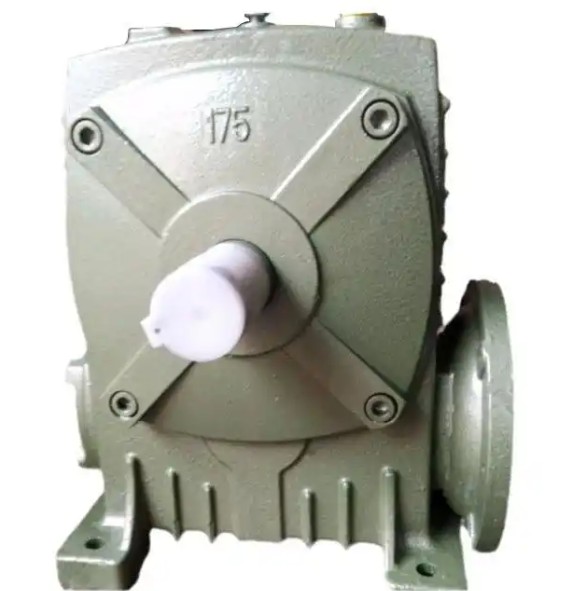
This test needs to be conducted in a no-load state where the gearbox is completely disconnected from the motor and load end, to eliminate external resistance interference:
Remove the motor connection flange of the reducer and the load coupling at the output shaft end to ensure that the reducer is in a free and unconstrained state without load.
Rotate the worm shaft (in the direction of motor drive) in the forward direction by hand or a special wrench, observe whether the worm shaft rotates smoothly, and confirm that there is no jamming fault inside the reducer.
Use your hand or wrench to drive the worm gear shaft in the opposite direction (simulating the reverse force at the load end), and try to rotate the worm gear shaft: if it cannot rotate or requires a great external force to be applied to force it to rotate (and the worm gear shaft will immediately reset after the external force is removed), it indicates that it has self-locking ability; If the worm gear shaft can be easily rotated and driven to rotate, it is determined that there is no self-locking ability.
Attention: During testing, it is necessary to ensure that the internal lubricating oil of the reducer is sufficient and the oil quality is normal. Poor lubrication can lead to a decrease in friction coefficient, which may be mistaken as self-locking failure.