How to realize self-locking of WPDA155-25-4KW worm gear reducer in material conveying equipment
The WPDA155-25-4KW worm gear reducer achieves self-locking in material conveying equipment by utilizing the transmission characteristics of the worm gear pair. When the lead angle of the worm gear is less than the equivalent friction angle of the worm gear meshing, the transmission can only be driven by the worm gear, and cannot be driven in the opposite direction by the worm gear. This prevents the conveying equipment from moving in the opposite direction due to material gravity or inertia during shutdown. The specific implementation methods and precautions are as follows:
1. Confirm the self-locking characteristic parameters of the gearbox itself
The transmission ratio of WPDA155-25-4KW reducer is 25, which belongs to a large transmission ratio worm gear reducer. Its worm lead angle design is usually small.
The core condition for self-locking is that the worm lead angle γ ≤ equivalent friction angle ρ. For the pairing of steel worm gears and tin bronze worm gears (commonly used configurations in material conveying equipment), the equivalent friction angle ρ is generally 3 °~5 °, while the worm lead angle γ corresponding to a transmission ratio of 25 is usually 1.5 °~2.5 °, meeting the self-locking condition.
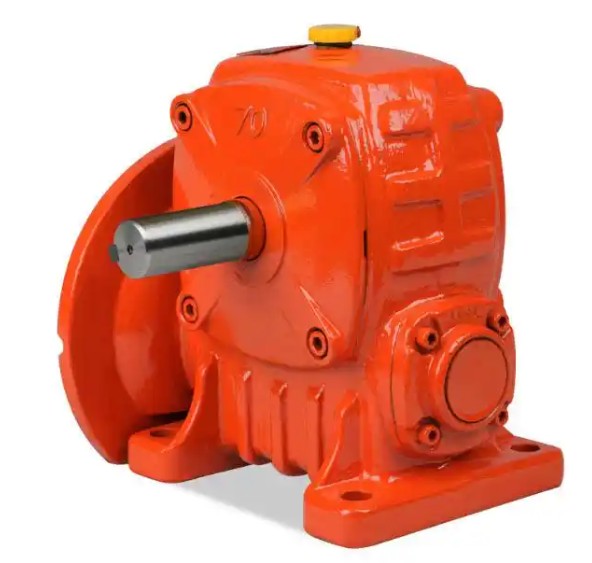
Selection verification: It is necessary to check the technical manual of the reducer model and confirm the "self-locking" attribute marked; If the manual is not clear, it can be verified through a simple test - after stopping the machine, apply external force (such as torque corresponding to material gravity) to the load end of the conveying equipment, and observe whether the output shaft rotates. If it does not rotate, it indicates that it has self-locking ability.
2. Optimize installation and match working conditions to ensure self-locking reliability
Even if the gearbox itself has a self-locking design, it is necessary to avoid self-locking failure through reasonable installation and operating condition control:
Control load direction: The load torque of the material conveying equipment needs to act vertically on the meshing surface of the worm gear to avoid lateral force or bias load that may cause an increase in meshing clearance and damage the self-locking condition. For example, the drum of a belt conveyor needs to be installed coaxially with the output shaft of the reducer, and the screw shaft of a screw conveyor needs to be precisely aligned with the output shaft of the reducer.