How to determine whether the installation reference surface of FF78-Y4-4P-21.43-M1 reducer is flat
To determine whether the installation reference surface of FF78-Y4-4P-21.43-M1 reducer is flat, a method of tool inspection and fitting verification should be used, with precise steps that can be directly operated:
1. Prepare testing tools
Select a frame level with an accuracy level of ≥ 0.02mm/m, a feeler gauge with an accuracy of 0.02mm, and a clean ruler (with a length not less than the diagonal length of the reference plane).
2. Multi point detection of level instrument
Record the bubble offset of the level in sequence. The flatness error of each position is required to be ≤ 0.1mm/m, and the height of local protrusions should not exceed 0.05mm. If the deviation of bubbles exceeds the tolerance, mark the excess area and carry out grinding treatment.
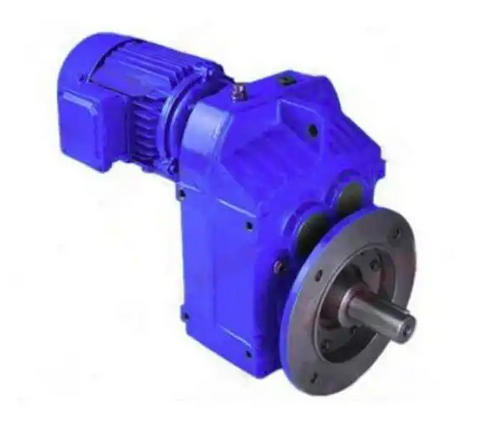
3. Flat ruler+feeler gauge fitting detection
Insert a 0.05mm feeler gauge into the gap between the straightedge and the reference plane in the longitudinal, transverse, and diagonal directions, with the straightedge tightly attached to the reference plane. If the feeler gauge cannot be inserted, it is considered qualified; If it can be inserted, it indicates the presence of a depression or protrusion, which needs to be scraped or polished until it is qualified.
4. Base trial installation verification
Place the reducer base (or mounting pad) on the reference surface, pre tighten the anchor bolts in diagonal order (with a torque of 50% of the specified value), and use a 0.05mm feeler gauge to check the fit gap along the edge of the base and the stress point. The entire process is smooth with no gaps as the reference surface; Local gaps exceeding the standard should be filled with thin gaskets (thickness ≤ 0.2mm) at a single point, and it is forbidden to stack multiple gaskets.
5. Re inspection after fastening
After tightening all the anchor bolts to the standard torque, use a spirit level to check the flatness of the reference surface again and confirm that there is no deformation before formally installing the reducer body.