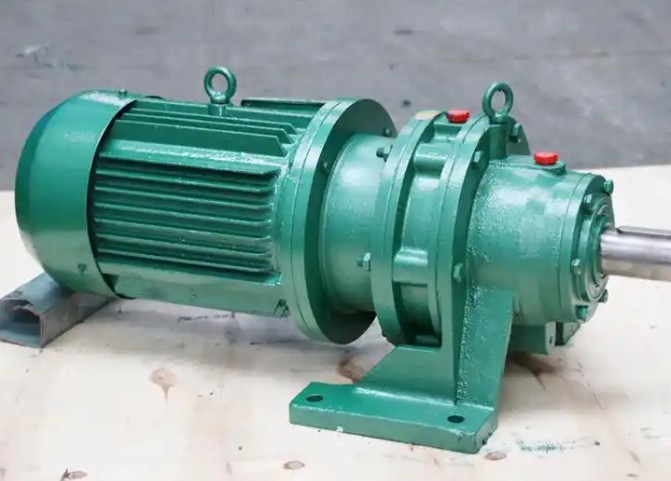
Introduce the material and structure of the output shaft of BWY0-17-0.75KW cycloidal pinwheel reducer
The material and structure of the output shaft of BWY0-17-0.75KW cycloidal pinwheel reducer are as follows:
1、 Output shaft material
The output shaft of BWY0-17-0.75KW (0.75kW, speed ratio 17, machine base 0) cycloidal pinwheel reducer is mainly made of 45 # high-quality carbon structural steel, which is quenched and tempered (HB220-250) before use. Key parts (shaft neck, keyway, pin hole) can be locally quenched with high frequency (HRC45-50) to improve wear resistance and fatigue resistance.
1. Core advantages: Balanced strength, toughness, and machinability, moderate cost, suitable for medium and low power, medium and low-speed working conditions;
2. Alternative solution: 40Cr (quenched and tempered+surface quenched) can be selected for heavy-duty/harsh working conditions to enhance load-bearing and impact resistance capabilities;
3. Key parameters: Tensile strength ≥ 600MPa, yield strength ≥ 355MPa, meeting the impact and alternating load requirements of cycloidal transmission.
2、 Output shaft structure
Main body of shaft: Solid stepped shaft structure, gradually transitioning in diameter (to avoid stress concentration), coaxially assembled with output flange, bearings, and cycloidal gear output mechanism to ensure transmission accuracy and rigidity.
1. Input end (connected to the cycloidal gear output mechanism):
The core is the pin shaft hole group (usually 6-8 evenly distributed through holes), used for threading the output pin shaft, transmitting the low-speed rotational torque of the cycloid wheel to the output shaft, and the hole wall needs to be precision machined to ensure coaxiality and positional accuracy;
A positioning step/retaining ring groove is set at the shaft end to limit the axial movement of the pin shaft and prevent assembly deviation.
2. Middle section (bearing support section):
Two precision shaft necks are installed with deep groove ball bearings (or tapered roller bearings) to support the output shaft and withstand radial loads and a small amount of axial force;
The surface roughness Ra of the journal is ≤ 1.6 μ m, with a tolerance fit of h6/g6, ensuring the accuracy of bearing installation and smooth operation;
Set up bearing positioning steps/locking nut slots to achieve axial positioning of the bearing and avoid movement during operation.
3. Output end (connected to the load segment):
Shaft extension section: standard cylindrical shaft extension, machined with flat keyway (GB/T 1095 standard), connected to load components such as couplings, sprockets, gears, etc. through flat keys to transmit torque;
Shaft end chamfer: C2-C4 chamfer, easy to assemble, preventing sharp edges from damaging seals and fittings;
Shaft end threaded hole (optional): used for installing shaft end retaining rings or pressure plates, fixing couplings and other components to prevent axial detachment.