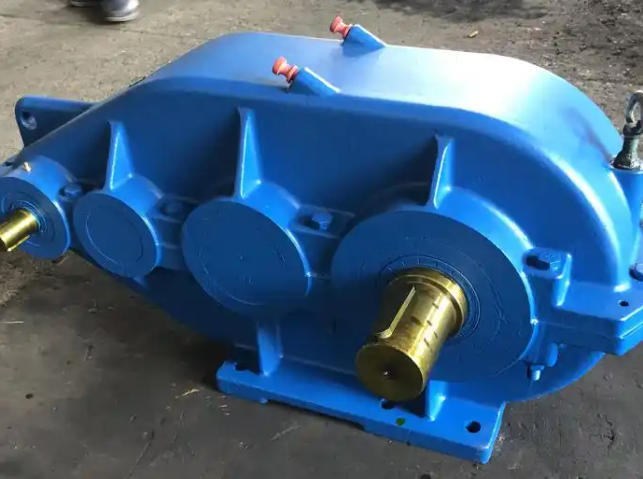
How to solve the uneven lubrication problem of ZSC350-Ⅱ-1 soft tooth surface reducer with flat oil pool design
The ZSC350-II-1 soft tooth surface reducer designed with a flat oil tank is prone to insufficient lubrication of high-speed gears and excessive oil agitation of low-speed gears due to uneven distribution of lubricating oil, which can lead to wear, temperature rise, and increased energy consumption. The most effective solution is to improve lubrication uniformity and operational reliability significantly through dual path collaborative improvement of structural optimization and maintenance management, without replacing the entire machine.
1、 Install a guide plate or oil baffle to optimize the internal oil flow direction
Install customized oil guide devices on the inner wall of the box or the side of the gear to actively guide the flow of lubricating oil to areas with weak lubrication:
For high-speed small gears: Install an arc-shaped oil guide plate above the oil tank to direct the oil flow carried by the large gear to the high-speed meshing area, compensating for its weak oil carrying capacity;
For low-speed large gears: set an oil baffle to limit the immersion depth, reduce oil stirring resistance, and lower power consumption and oil temperature;
It is recommended to use oil resistant rubber or engineering plastics as materials to avoid secondary pollution caused by metal debris falling off.
2、 Adjust the lubricating oil level to the optimal immersion depth, balancing efficiency and lubrication
Reasonable control of oil level is a fundamental measure to improve uneven lubrication:
High speed gears: It is recommended to immerse the oil surface to a depth of 1-2 tooth heights to ensure effective oil film formation;
Low speed gear: the immersion depth should not exceed 1/3 of the gear radius to avoid foam and heating caused by excessive oil stirring;
Use an oil dipstick with a tilt compensation scale and measure after 30 minutes of shutdown to ensure accurate readings.
3、 Choose lubricating oil with high fluidity and strong anti foaming properties to enhance lubrication adaptability
The performance of lubricating oil directly affects the lubrication distribution effect:
Recommend using ISO VG 220 or 320 L-CKD extreme pressure industrial gear oil, which has good extreme pressure anti-wear and anti-oxidation properties;
Under high temperature or heavy load conditions, PAO synthetic oil is preferred as it has good low-temperature fluidity and strong anti foaming properties, which helps improve the uniformity of oil film distribution;
A small amount of antifoaming agent (conforming to ISO 6743 standard) can be added to reduce foam caused by oil stirring and improve lubrication efficiency.
4、 Regularly clean oil sludge and impurities to prevent local blockages from affecting oil flow
The flat oil pool is prone to accumulating metal shavings and sludge, which affects the lubrication path:
Conduct oil testing every 6 months to check for moisture, acid value, and particulate matter content;
Thoroughly drain the old oil when changing the oil, and use kerosene or specialized cleaning agents to flush the dead corners at the bottom of the box;
Install magnetic oil drain plugs or built-in filters to adsorb iron abrasive particles and reduce the risk of abrasive wear.
5、 Consider retrofitting to a tilted oil tank in the later stage (suitable for long-term operating equipment)
If the equipment has a long service life and frequent failures, the feasibility of transforming it into a tilted oil tank can be evaluated:
The tilt angle is usually set at 3 °~5 ° to allow the lubricating oil to naturally flow towards the low-speed gear side, while optimizing the high-speed oil carrying trajectory;
The renovation needs to be implemented by the original factory or a professional organization to ensure that the strength, sealing, and oil level monitoring system of the box are upgraded synchronously;