What are the specific effects of different materials on the performance of WXJ120-31-3 worm gear reducer?
The core performance of WXJ120-31-3 worm gear reducer (load capacity, transmission efficiency, wear resistance, service life, operating noise) is directly determined by the material combination of worm gear and worm gear. At the same time, the materials of components such as housing and bearings also affect the stability of the whole machine. The specific effects are as follows:
1. The influence of worm material on performance
As an active component, the worm gear needs to withstand alternating loads and frictional wear. The hardness, strength, and heat treatment process of the material are key factors. Common materials and their effects are as follows:
(1) 45 # steel (quenched and tempered, hardness HB220-250)
Performance impact: Low cost, good processability, but low surface hardness, poor wear resistance, and transmission efficiency of only 70% -75%; Suitable for low-speed, light load, intermittent operation conditions, long-term operation is prone to tooth wear and bite, and the service life generally does not exceed 3000 hours.
Limitations: Unable to withstand the rated load continuous operation of WXJ120-31-3, only suitable for temporary replacement or non core transmission scenarios.
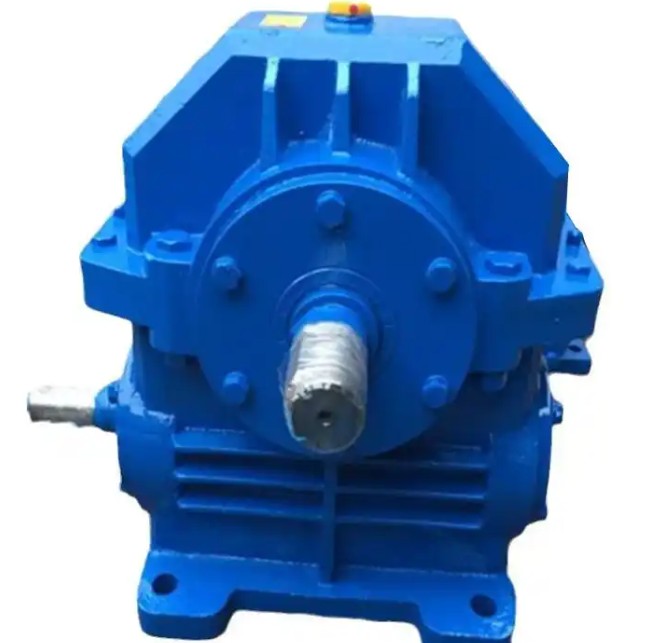
(2) 20CrMnTi (carburizing quenching, hardness HRC58-62, tooth surface grinding)
Performance impact: High surface hardness, good core toughness, excellent wear resistance, able to withstand high-frequency impact loads; The transmission efficiency has been improved to 80% -85%, and the tooth contact fatigue strength is high, making it less prone to pitting and peeling; Continuous operation under rated load, with a service life of up to 8000-12000 hours.
Adaptability: Matching with the conventional operating conditions of WXJ120-31-3 (input speed 1450r/min, within the rated torque range), it is the mainstream economical choice.
(3) 40CrNiMoA (quenched and tempered+surface nitrided, hardness HV850-950)
Performance impact: The surface hardness is extremely high, and the wear resistance and corrosion resistance are better than that of carburized steel. The friction coefficient is lower, and the transmission efficiency can reach 85% -90%; After nitriding treatment, the deformation of the tooth surface is small, and there is no need for subsequent grinding, resulting in good accuracy retention; Suitable for high-speed, heavy-duty, and humid environments, with a service life of over 15000 hours.
Limitations: High manufacturing cost, long processing cycle, suitable for scenarios with strict requirements for operational stability and lifespan (such as production lines running continuously for 24 hours).
2. The influence of worm gear material on performance
Worm gears are driven components that require good anti friction and anti adhesive properties. Common materials and their effects are as follows:
(1) Tin bronze (ZCuSn10Pb1, ZCuSn5Pb5Zn5)
Performance impact: Excellent anti friction performance, low friction coefficient when meshing with steel worm gear, less prone to adhesive failure, able to withstand high sliding speeds (≤ 10m/s); Good thermal conductivity, can quickly dissipate meshing heat, avoiding high temperature softening of the tooth surface; The transmission efficiency is 10% -15% higher than that of cast iron worm gears, and the service life can reach more than 10000 hours.
Adaptability: It is the optimal matching material for WXJ120-31-3 reducer, especially suitable for high-speed, heavy-duty, and continuous operation conditions. The disadvantage is that the cost is relatively high.