Introduce the working principle of WPEDS120-175-125-3KW worm gear reducer
The working principle of WPEDD120-175-125-3KW worm gear reducer is based on the helical meshing transmission between the worm gear and the worm wheel, which achieves a large transmission ratio of speed reduction and torque increase through the difference in tooth number. At the same time, it has the advantages of smooth transmission, compact structure, and some models can achieve self-locking.
1、 Core Structure: The "Spiral Partner" of Worm and Worm Gear
The core of this gearbox consists of two key components:
Worm: Similar in appearance to a screw, with helical teeth, usually used as an active component to connect to the input shaft of a motor. Depending on the number of heads (commonly single head or double head), it directly affects the size of the transmission ratio.
Worm gear: a circular gear with arc-shaped teeth that meshes with a worm and serves as a driven component to output power. Its number of teeth far exceeds the number of worm heads, which is the key to achieving a large reduction ratio.
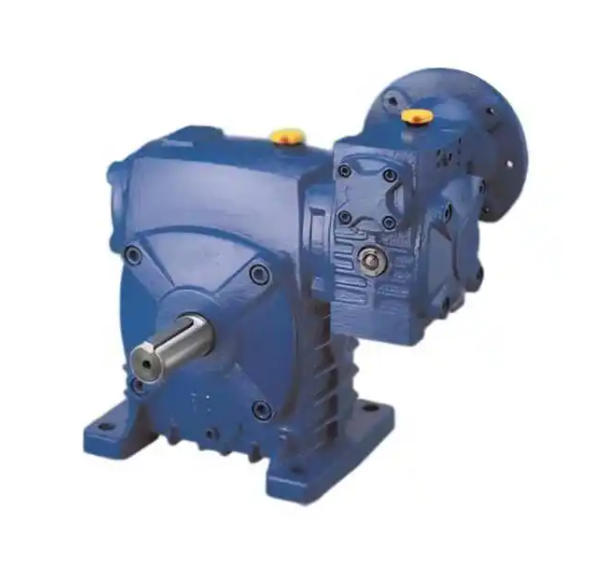
The two are arranged in a 90 degree staggered manner in space, neither parallel nor intersecting, forming a unique spatial meshing relationship.
2、 Transmission process: "push type" meshing of helical teeth
When the motor drives the worm to rotate, its helical tooth surface will continuously push the teeth of the worm wheel, causing the worm wheel to rotate around its own axis. The specific process is as follows:
1. Transmission of force: When the worm rotates, the spiral teeth form a linear contact with the worm wheel teeth, with a large contact area and uniform force distribution, resulting in smooth transmission and low noise.
2. Direction change: Due to the worm gear being perpendicular to the worm wheel axis, a 90 ° turn is achieved during power transmission, making it suitable for vertical or angular transmission scenarios.
3. Motion form: Although similar to "screwing a nut", it is actually a rotational motion transmission rather than a linear motion.