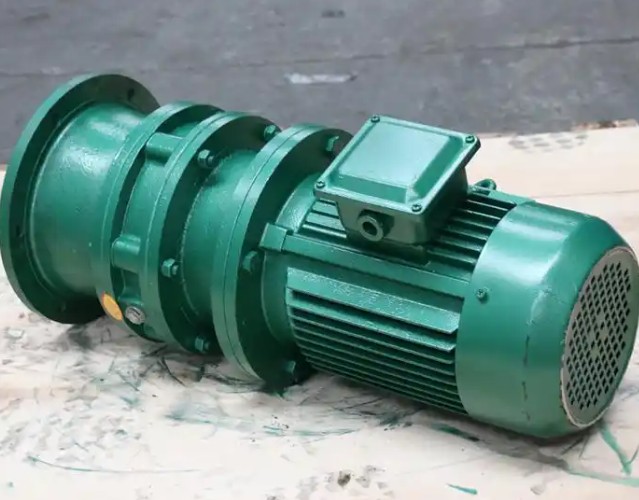
BL3-17-7.5KW cycloidal pinwheel reducer output shaft keyway standard
The keyway standard for the output shaft of BL3-17-7.5KW cycloidal pinwheel reducer is mainly designed based on the shaft diameter size, torque transmission requirements, and the national standard GB/T 1095-2003 "Sectional Dimensions of Flat Key Keyways". Flat key connections are usually used to balance torque transmission and assembly convenience.
1、 Core parameters of output shaft keyway (inferred based on common BL series specifications)
Although the official keyway data for the specific model BL3-17-7.5KW needs to be consulted in the manufacturer's technical manual, according to the general design specifications for cycloidal pinwheel reducers, it can be inferred that the output shaft keyway parameters are as follows:
Note: The actual dimensions should be based on the product nameplate or manufacturer's drawings. During assembly, it is necessary to ensure that the key and keyway sides are tightly fitted, with a gap of 0.1-0.3mm at the top to avoid interference and stress concentration.
2、 Suggestions for selecting keyway types
Flat key (preferred)
The structure is simple and easy to disassemble, suitable for working conditions with moderate torque and no significant axial force, such as conveyors, mixing equipment, etc. It is the most commonly used connection method for cycloidal pinwheel reducers.
Spline (optional in high torque scenarios)
If the equipment frequently starts and stops or transmits large torque (such as crushers), involute splines can be considered, which have a load-bearing capacity 2-3 times that of flat keys, but have high processing costs and are mostly used for large-sized models.
Wedge key (not recommended)
Although it can withstand slight axial forces, it will produce eccentricity, affecting the smoothness of transmission, and is less commonly used in precision oriented cycloidal pinwheel reducers.
3、 Installation and matching precautions
Size matching: The width and depth of the keyway must be exactly the same as the keyway in the inner hole of the coupling or transmission component, with an error not exceeding 0.1mm, otherwise it may cause uneven stress and shear fracture of the key.
Surface quality: Both sides of the keyway should be smooth and free of burrs, with a roughness Ra ≤ 3.2 μ m, to prevent stress concentration from causing fatigue cracks.
Positioning measures: Flat key connections should be used in conjunction with shaft shoulders or fastening screws to prevent axial movement of the wheel hub.
Standard basis: The design should comply with the GB/T 1095-2003 and flat key standards, while referring to international standards such as ISO 2338 to ensure interchangeability.