What are the precautions for tightening the foundation bolts of BWED131-391-1.5KW cycloidal pinwheel reducer
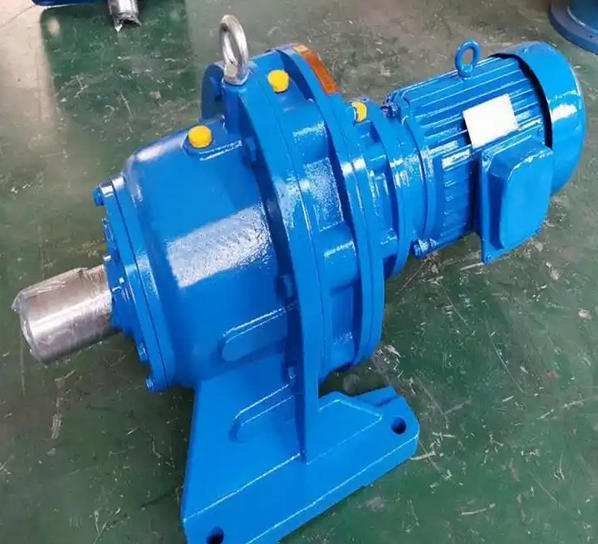
BWED131 is a two-stage horizontal cycloidal pinwheel reducer. The vibration impact of the 1.5KW power model is slightly greater than that of the low-power model during operation. The core of tightening the foundation bolts is to ensure that the machine base is uniformly stressed and deformation free, and to avoid bolt loosening or machine base warping. The specific precautions are as follows:
1. Preparation confirmation before tightening
Before tightening the bolts, it is necessary to retest the levelness of the machine base to ensure that the longitudinal and transverse horizontal errors are ≤ 0.05mm/m; Clean the oil stains and iron filings on the threads of the anchor bolts and the end faces of the nuts. Apply a small amount of anti seize agent (such as copper paste) to avoid thread sticking; Confirm that the pad iron under each set of anchor bolts is tightly fitted, and the depth of the 0.05mm feeler gauge inserted should not exceed one-third of the width of the pad iron.
2. Strictly follow the diagonal step-by-step tightening sequence
This type of reducer is generally equipped with 4 anchor bolts, which are tightened in three rounds according to the diagonal distribution principle, and it is strictly prohibited to tighten them in sequence on one side.
First round: In the diagonal order of "top left → bottom right → top right → bottom left", tighten the bolts to 30% of the rated torque. After completion, retest the levelness. If there is a deviation, adjust the shim to correct it. It is forbidden to forcefully level by tightening the bolts.
Second round: Increase the torque to 70% of the rated torque in the same diagonal order. After tightening, gently tap the side of the machine base to release stress and check that there is no gap between the machine base and the foundation.
Third round: Tighten in diagonal order to the rated torque value. The BWED131 model is mostly equipped with M12-M14 bolts, and the rated torque reference value is 25-35N · m. Please refer to the equipment manual for details.
If the reducer is equipped with 6 anchor bolts, tighten them in three rounds according to the principle of "diagonal spacing" to ensure even force distribution.
3. Detail requirements for controlling the tightening process
Use a torque wrench when tightening, and do not use an extension rod or brute force to strike the wrench to prevent bolt overload, breakage, or thread slippage.
In the same round of tightening, the torque deviation of each bolt should be controlled within ± 5% to avoid excessive force on individual bolts.
During the tightening process, observe the deformation of the machine base in real time. If there is any output shaft rotation jamming, stop tightening immediately and investigate the gap or horizontal deviation of the shim.
4. Tightened anti loosening and verification
After tightening the bolts to full torque, install the anti loosening components. Priority should be given to using a combination of spring washers and anti loosening nuts, or applying medium strength thread locking agent (such as 243 model). Bolt protection covers should be installed outdoors or in humid environments.
Manually rotate the output shaft of the gearbox to ensure flexible rotation without any jamming; Run the test without load for 15-20 minutes. After stopping, use a torque wrench to recheck the bolt torque. If there is no attenuation, it is considered qualified.