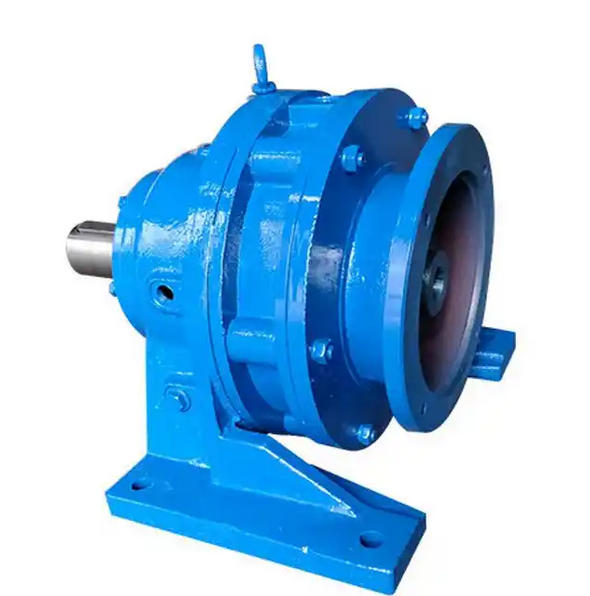
What is the impact of motor rotation error on the transmission efficiency of XWD3-0.55KW cycloidal pinwheel reducer
The motor turning error will not directly reduce the theoretical transmission efficiency of the XWD3-0.55KW cycloidal pinwheel reducer (its transmission efficiency is determined by the internal structure, lubrication status, and wear degree, and is not related to the steering), but it will indirectly affect the operating status of the equipment, resulting in a decrease in actual transmission efficiency, an increase in energy consumption, and even causing faults. The specific impact is as follows, which is in line with the characteristics of this type of reducer (XWD3 series, power 0.55KW, cycloidal pinwheel structure):
1、 Core impact: No direct efficiency loss, but significant indirect loss
Theoretical level: The transmission principle of the cycloidal pinwheel reducer is "cycloidal gear and pinwheel meshing transmission", with a symmetrical structure of meshing. When rotating in both directions, the number of meshing teeth and transmission ratio (XWD3 series conventional transmission ratio 17-100) remain unchanged. Therefore, the theoretical transmission efficiency (usually 85% -95%, close to 90% for 0.55KW low-power models) does not differ and will not directly decrease due to steering errors.
In practical operation, steering errors can cause the equipment to experience "reverse force", leading to a series of abnormalities and indirectly reducing the actual transmission efficiency
Abnormal lubrication system: The internal lubrication oil circuit and oil level of the reducer are designed to adapt to forward operation. When rotating in reverse, the circulation speed of the lubricating oil slows down, and some meshing parts (such as cycloidal gear teeth and needle teeth) are not sufficiently lubricated, resulting in increased frictional resistance and mechanical losses. The actual transmission efficiency decreases by 3% -8% (depending on the lubrication status).
Load misalignment: If the working machine (such as conveyor or mixer) matched with the reducer has a fixed load direction, the motor rotation error will cause the load to be opposite to the output direction of the reducer, forming a "reverse load resistance". At this time, the reducer needs to consume additional power to overcome the reverse resistance, resulting in a decrease in actual transmission efficiency and an increase in motor current. Long term operation will further exacerbate losses.
2、 Derivative effects: exacerbating component wear, indirectly leading to a sustained decrease in efficiency
Accelerated wear of seals: Incorrect steering can change the direction of force on the output shaft of the gearbox, resulting in uneven force distribution on the output shaft oil seal and end cover seal, leading to seal loosening and leakage. After the loss of lubricating oil, the friction between internal meshing components intensifies, not only causing a continuous decrease in transmission efficiency, but also possibly causing component jamming.
Abnormal wear of meshing components: The meshing surface of the cycloid wheel and the needle wheel is designed to adapt to forward force. When rotating in reverse, the force point on the meshing surface shifts, and local wear intensifies. Long term reverse operation can lead to tooth surface wear, increased clearance, mechanical vibration and noise, further increasing transmission losses, and ultimately resulting in actual transmission efficiency dropping below 70%.
Auxiliary component loss: For XWD3-0.55KW reducers with backstops, steering errors can cause the backstops to be forcibly stressed and stuck, which not only increases operating resistance but may also damage the backstops, indirectly increasing power loss and reducing overall transmission efficiency.