How to determine if the malfunction of WPDKA100-40-A worm gear reducer is caused by installation issues
To determine whether the malfunction of the WPDKA100-40-A worm gear reducer is caused by installation issues, the core is to eliminate other factors such as manufacturing, wear, and lubrication, focus on typical hidden dangers in the installation process, combine fault phenomena with practical testing, and accurately locate. The specific methods are as follows, which are in line with the structural characteristics of this model of reducer (WPDKA series, model 100, speed ratio 40):
1、 First, clarify the core characteristics of installation related faults (quick preliminary judgment)
Malfunctions caused by installation issues often occur during the initial operation and maintenance of a new machine, and are directly related to installation deviations. There are no obvious signs of component wear, and common features include:
1. Abnormal vibration and abnormal noise (such as "clang" and "friction" sound) occur during operation, and the vibration/abnormal noise intensifies with the increase of load. After stopping, manual turning is not stuck, but the hand feel is uneven during rotation;
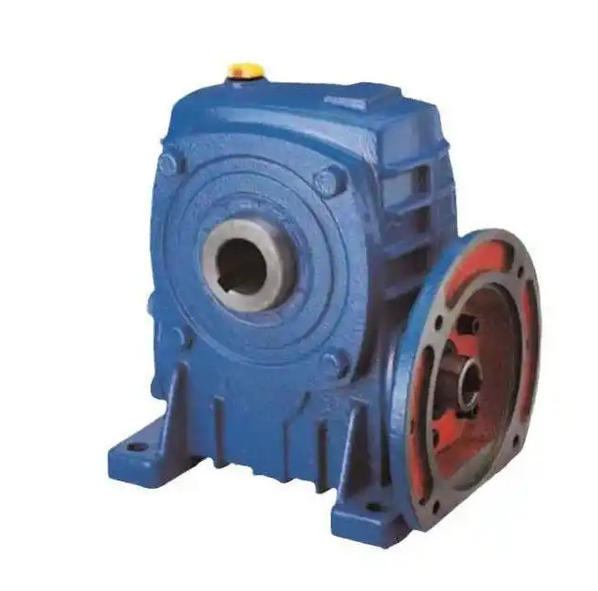
2. The connection between the reducer, motor, and working machine (coupling) heats up too quickly, or the coupling bolts are loose and unevenly worn;
3. Lubricating oil leakage is concentrated at the connection between the end cover, bearing seat, and housing, and the sealing components are checked for aging and damage;
4. Abnormal output shaft speed, insufficient torque, or "loss of rotation" when driving the working machine, but the motor is running normally and there are no signs of gear wear inside the reducer;
5. The bearing area rapidly heats up in the short term (exceeding 80 ℃), and there is no improvement after replacing the lubricating grease, ruling out the quality problem of the bearing itself.
2、 Targeted practical testing (precise verification, core steps)
1. Coaxiality testing of couplings (the most critical, installation deviation is the most likely to cause this problem)
The WPDKA100-40-A reducer is often connected to motors and working machines through couplings, and excessive coaxiality during installation is the most common cause of failure. Testing method:
Use a dial gauge (or micrometer) to fit the end face and outer circle of the coupling, slowly rotate the coupling once, and observe the reading on the dial gauge:
The allowable deviation for end face runout (deviation angle misalignment) is ≤ 0.05mm, and the allowable deviation for outer circle runout (parallel misalignment) is ≤ 0.03mm;
If the reading exceeds the standard, it indicates that the axis of the reducer and the motor/working machine are not aligned during installation (parallel offset or angular offset), and the fault is caused by installation deviation.
Addendum: If the coupling is a plum blossom coupling or an elastic coupling, observe whether the elastic body is subjected to uneven force, unilateral wear, or misaligned bolt holes, which are also direct manifestations of improper installation.
2. Inspection of the base and fixing bolts (faults caused by loose installation)
Check whether the plane of the reducer base is flat, measure with a level, and the horizontal deviation should be ≤ 0.2mm/m. If the base is tilted or the shim is loose, it will cause deformation of the reducer housing and cause internal component misalignment;
Check the anchor bolts and end cap bolts one by one. If there is looseness or uneven tightening force, it will cause vibration during operation, resulting in abnormal meshing of bearings, worm gears, and worm gears. This is a fault caused by improper installation operation;
Observing the connection surface between the base and the foundation, if there are gaps, insufficient number of shims, or uneven placement, it can also cause displacement and vibration during operation.