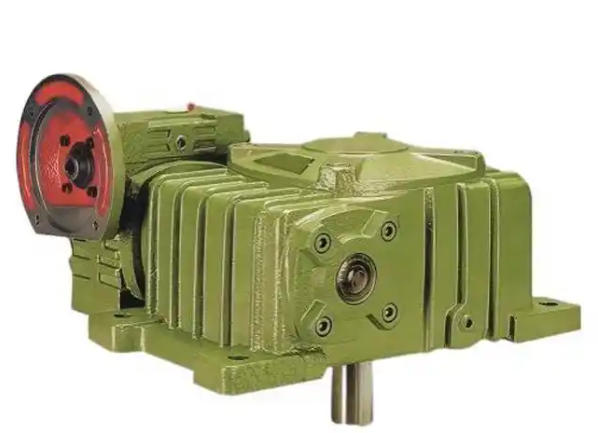
What material is usually used for the output shaft of WPEDX135/200-3KW worm gear?
The output shaft (worm shaft) of a two-stage worm gear reducer such as WPEDX135/200-3KW has the following industry standard materials and heat treatment:
1、 Mainstream materials (sorted by popularity)
1. 45 # steel (high-quality carbon structural steel)
The most conventional and economical choice.
Heat treatment: Quenching and tempering (HB 217-255) to ensure a balance between strength and toughness.
Applicable: General working conditions, low to medium torque (≤ 1000N · m).
2. 40Cr (alloy structural steel)
The preferred choice for medium to high load, frequent start stop/impact conditions.
Heat treatment: quenching and tempering (HB 269-302); Oil seals/journal positions are often subjected to high-frequency quenching (HRC 45-55) to enhance wear resistance.
Strength: Tensile strength ≥ 785MPa, yield strength ≥ 635MPa, fatigue and torsion resistance better than 45 #.
3. 42CrMo (high-strength alloy structural steel)
Optional for heavy load, high torque, and harsh working conditions (such as mining and lifting).
Heat treatment: quenching and tempering (HB 280-320), with stronger comprehensive mechanical properties.
2、 Typical configuration of WPEDX135/200-3KW
Standard factory: 45 # steel quenched and tempered (with the highest cost-effectiveness).
Reinforced/customized: 40Cr quenching and tempering+high-frequency quenching of the shaft neck (more durable and longer service life).
Very rarely used: 42CrMo (unless explicitly overloaded/impacted).
3、 Why not use copper/stainless steel
The output shaft is a torque transmission shaft that requires high strength, high toughness, torsion resistance, and fatigue resistance;
Copper alloy is too soft and lacks strength; Stainless steel has high cost and difficult processing, and is only used in special anti-corrosion scenarios.