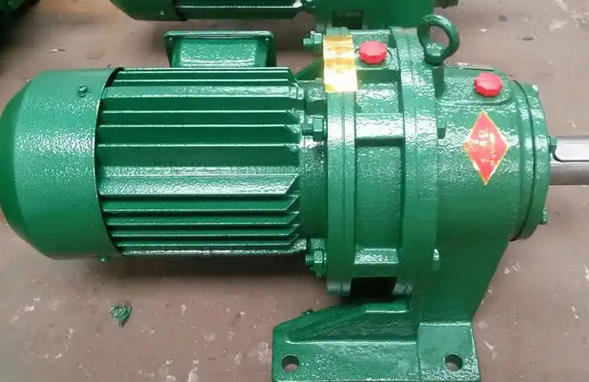
How to straighten the cycloidal gear of XWD9170-87-4KW reducer after heat treatment
After heat treatment, the cycloidal gear is straightened, and the core is to choose cold or hot calibration according to the degree of deformation and material characteristics, and strictly control the process details. The specific method is as follows:
1、 Selection of straightening methods
Cold straightening (suitable for slight deformations)
Apply reverse pressure to the bent part using a press or jack, gradually correcting it in multiple steps to avoid overload.
Simple operation and low cost, but there may be residual stress, requiring subsequent tempering treatment (around 200 ℃).
Hot straightening (suitable for materials with large deformations or high hardness)
Flame heating method: Use an oxygen acetylene flame to heat the curved convex surface to 500-700 ℃ (low carbon steel can reach 900 ℃). The heating method can be spot (diameter 20mm, spacing 50mm) or linear (120 ° circumference range). After heating, quickly cool down and correct using the principle of thermal expansion and contraction.
Oven heating method: Heat the deformed part to 800-900 ℃ (light red), remove it and hammer it for correction. Use a circular arc mold to protect the surface.
The hot straightening effect is more thorough, but the operation is complex and requires experienced personnel to control the temperature to avoid overheating.
2、 Operation points
Testing first: Use a micrometer or laser measuring instrument to measure the curvature, and if it exceeds 0.02mm/m, it needs to be straightened.
Temperature control: When heated by flame, low carbon steel can reach 900 ℃, and medium high carbon steel is recommended to reach 500-700 ℃.
Protective measures: Use a circular arc mold to prevent surface damage during hammering, and cool naturally after heating to avoid secondary deformation.
3、 Precautions
Cold straightening: Apply pressure multiple times to avoid overloading and cracking.
Hot straightening: Heating should be uniform to avoid local overheating; After cooling, retest. If it does not meet the standard, repeat.
Material difference: High carbon steel should be heated with flame with caution, as it is prone to overburning; Alloy steel is recommended to be heated in an oven.
4、 Suggestions for process optimization
Preventing deformation: Optimize forging and preliminary heat treatment, control heating temperature and time, and adopt processes such as graded quenching.
Post straightening treatment: After cold calibration, tempering (200 ℃) is required to relieve stress; Check the hardness after hot calibration and re quench if necessary.