What impact does temperature change have on the transmission efficiency of ZQD750-121-4 gear reducer?
The influence of temperature changes on the transmission efficiency of ZQD750-121-4 gear reducer is mainly reflected through three core paths: changes in lubricating oil performance, thermal deformation of components, and changes in friction pair state. The specific effects and rules are as follows:
1. Negative effects of low temperature environment (ambient temperature<-10 ℃, oil temperature not reaching working temperature)
The viscosity of lubricating oil increases sharply, the fluidity deteriorates, and the friction pairs such as tooth surfaces and bearings cannot form a stable oil film. The proportion of dry friction and semi dry friction increases, and the mechanical friction loss increases significantly. The transmission efficiency decreases by 8% -15% compared to room temperature.
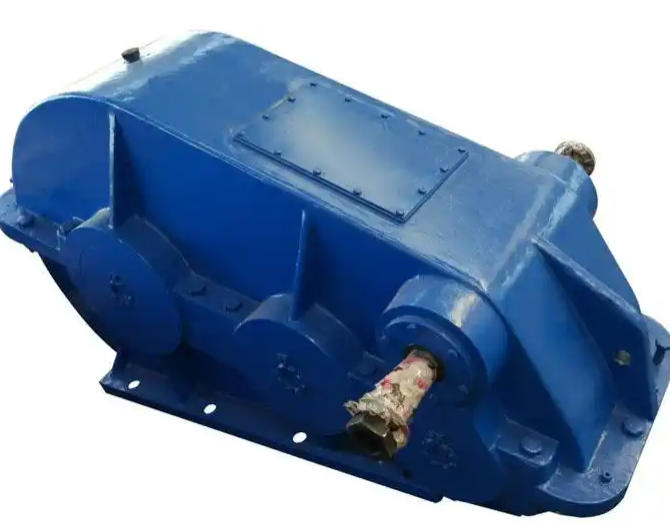
Low temperature hardening of rubber seals increases the resistance of shaft system operation; At the same time, the metal components shrink at low temperatures, resulting in a decrease in gear meshing clearance and an additional increase in meshing resistance, further reducing transmission efficiency.
The efficiency drops the most during low-temperature start-up, and after 10-15 minutes of no-load operation, the oil temperature rises and the efficiency gradually recovers.
2. Positive effects of suitable temperature range (oil temperature 40 ℃ -80 ℃)
The viscosity of lubricating oil is in the optimal range, which can form a uniform and sufficiently strong oil film on the tooth surface and bearing roller surface, effectively isolate metal contact, minimize friction loss, and stabilize transmission efficiency at the design value (usually 94% -96%).
The thermal expansion of metal components is moderate, and the gear mesh clearance and bearing clearance are in an ideal fit state without additional resistance, ensuring stable transmission efficiency.
3. Negative effects of high temperature environment (oil temperature>90 ℃, long-term over temperature operation)
The viscosity of lubricating oil significantly decreases, the oil film strength is insufficient, and oil film rupture is prone to occur. When the tooth surface meshes, the metal contact area increases, the friction loss increases, and the transmission efficiency decreases by 5% -10%; At the same time, high temperature accelerates the oxidation and degradation of lubricating oil, generating oil sludge impurities, further exacerbating friction losses.
Uneven thermal expansion of metal components such as the casing, gears, and shafts leads to deviation in the parallelism of the gear axis, uneven meshing load, poor contact spots, increased meshing impact and friction losses, and continuous efficiency reduction.
High temperature increases the clearance between the bearing rollers and the raceway, reduces operational accuracy, increases bearing friction losses, and subsequently lowers the overall transmission efficiency of the machine.
4. The superimposed effect of frequent temperature fluctuations
The repeated rise and fall of temperature causes periodic changes in gear mesh clearance and bearing clearance, unstable friction pair state, and additional alternating stress loss, resulting in a fluctuation range of transmission efficiency of 3% -8%.
Seals and fasteners may become fatigued and loose due to temperature fluctuations, increasing the resistance to shaft movement and indirectly reducing transmission efficiency.