WPEDA80-135-400 worm gear reducer structure and material description
1、 Overall transmission structure design
1. Transmission series and principle
This model of reducer adopts a two-stage worm gear transmission structure, which achieves a large transmission ratio output of 1:400 through the meshing transmission between the two-stage worm gear and the worm wheel. The first stage is high-speed transmission, with the worm connected to the motor output shaft, responsible for deceleration and initial torque amplification in the high-speed section; The second stage is the low-speed transmission, which receives the power output of the high-speed stage, further reduces the speed and increases the torque, and ultimately outputs stable low-speed high torque power. Compared to single-stage worm gear reducers, the two-stage transmission structure can effectively reduce the overall size and weight of the machine, improve operational stability, and reduce the meshing pressure of the single-stage transmission pair while achieving a large transmission ratio.
2. Structural layout form
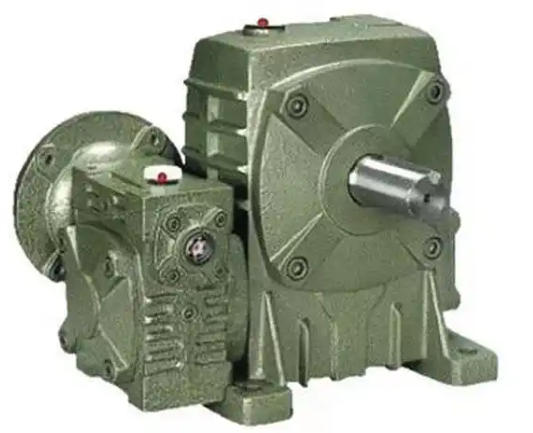
The "D" in the model represents that its transmission layout is vertically distributed with input and output, and the input shaft and output shaft form a 90 ° angle, which is suitable for the installation space requirements of various industrial equipment. The reducer is installed horizontally as a whole, and the box is equipped with symmetrical installation flanges and anchor bolt holes, which can support direct installation of flanges or be fixed on rigid foundations through anchor bolts. The input end is equipped with a standard motor connection flange, which can be directly connected to the compatible motor for installation without the need for additional couplings, simplifying the installation process; The output end adopts a flat key connection structure, and the keyway size meets national standards, which can be directly matched with actuators such as sprockets, gears, couplings, etc.
3. Auxiliary structural design
The box is equipped with a reinforced rib structure, distributed at the connection between the side wall of the box and the flange, to enhance the rigidity of the box, reduce vibration and deformation during operation, and avoid affecting the meshing accuracy of the worm gear due to box deformation.
Equipped with an oil level observation window and a drain plug, the oil level observation window is located in the middle of the side of the box, making it easy to visually monitor the amount of lubricating oil; The oil drain plug is located at the lowest point at the bottom of the box, making it easy to drain old oil when replacing lubricating oil.
The top of the box is equipped with a breathable plug, which can discharge the oil and gas generated in the box due to the increase of oil temperature during operation, balance the air pressure inside and outside the box, and prevent lubricating oil leakage due to high air pressure.
2、 Key component materials and processes
1. Worm components
The material used is 20CrMnTi alloy steel, which has good hardenability and toughness. After carburizing and quenching treatment, the tooth surface hardness can reach HRC58-62, and the tooth core maintains good toughness and can withstand large impact loads.
In terms of processing technology, the worm gear tooth surface is precision ground and processed, with a precision level of 6 in accordance with the GB/T 10089-2018 standard. The tooth surface roughness Ra is ≤ 0.8 μ m, reducing the friction coefficient during meshing and improving transmission efficiency and service life. The worm is equipped with high-precision tapered roller bearings at both ends to ensure rotational accuracy and reduce radial and axial play.
2. Worm gear components
The material selected is tin bronze ZCuSn10Pb1, which has excellent anti friction, wear resistance, and anti bonding ability. When matched with hard tooth surface worm gears, it can form a good oil film, avoiding wear and bonding failure caused by direct metal contact. It is the preferred material for worm gear transmission pairs.