What are the differences in gear parameter selection between ZS95 soft tooth surface reducer and other types of reducers
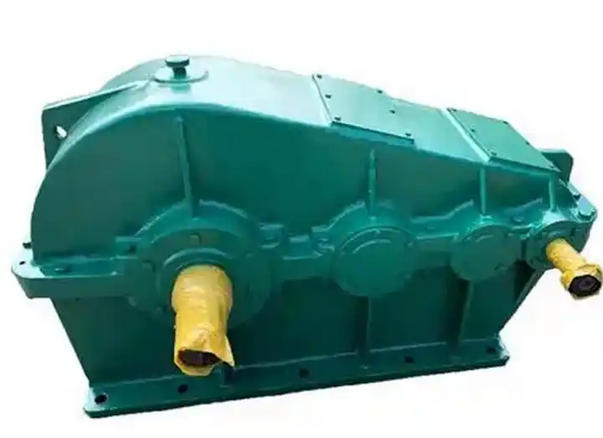
ZS95 is a three-stage involute helical soft tooth surface cylindrical gear reducer (with a center distance of about 950 mm). The core of its gear parameter selection is to balance load, smoothness, and cost under the soft tooth surface tempering process and three-stage transmission constraints. The differences from hard tooth surfaces, straight teeth, bevel teeth/worm gears, planets, etc. are concentrated in material heat treatment, accuracy level, tooth number/module/helix angle, tooth width coefficient, and transmission ratio distribution. The following is a specific explanation:
1. Differences in Materials and Heat Treatment
ZS95 soft tooth surface is mainly quenched and tempered with 45/40Cr, with a tooth surface hardness of ≤ 350 HBS. Rolling teeth can meet batch and cost requirements, suitable for medium low speed, medium light load, and cost sensitive scenarios; Hard tooth surface reducers commonly use alloy steel carburizing and quenching (≥ 58 HRC), which requires gear grinding and precision machining, significantly improving load capacity and service life, but with high cost and process threshold; Straight tooth reducers are often made of the same material as soft tooth surfaces, but without helix angles, resulting in greater impact and noise; In bevel/worm gear reducers, bevel teeth are often paired with quenched/ground teeth, while worm gears are mostly made of tin bronze/steel quenched and tempered, making them more sensitive to tooth contact and lead errors; The sun/planet gears of planetary reducers are often carburized, quenched, and ground, while the ring gears are quenched or tempered, requiring high requirements for load sharing and backlash control.
2. Accuracy level difference
ZS95 soft tooth surface is selected according to GB/T 10095, with 8 levels for conventional use and 7 levels for noise reduction/high-speed conditions. The tooth surface Ra is ≤ 3.2 μ m; Hard tooth surfaces and planetary gearboxes are commonly used in 6-7 stages, with gear grinding processing, Ra≤1.6 μm, Better load-bearing and stability; Straight tooth reducers are mostly 8-9 levels, with high impact and noise; The bevel teeth of bevel/worm gear reducers are commonly used in 7-8 stages, and the worm gear is in 7-8 stages. The lead error has a significant impact on efficiency and heat generation, requiring higher precision control.
3. Difference in number of teeth/module/helix angle
ZS95 soft tooth surface small gear teeth z1 ≥ 18 (anti root cutting), moderate modulus, helix angle β=8 ° -15 °, three-stage transmission ratio distribution to balance load and speed at all levels, improve coincidence, reduce impact, and control axial force; Straight tooth reducers have no helix angle, low overlap, and high impact, z1≥17, The transmission ratio range is limited; The hard tooth surface reducer z1 can be smaller, with a more compact module and slightly larger β, giving priority to load capacity; Cone gear reducer z1 ≥ 12-15, limited by cone top distance; The number of worm gear reducers is 1-4, and the lead angle determines efficiency and self-locking; The planetary gearbox has fewer teeth and smaller module, relies on the planetary carrier for uniform load, has a small volume, and high torque density.