What problems will the center distance deviation of ZLY200-9-1 reducer gear cause?
The center distance deviation (including positive and negative deviations) of ZLY200-9-1 reducer gears can directly damage the normal meshing state of the gears and cause a series of transmission failures. The specific problems are as follows:
1. Serious and poor gear contact spots
Positive deviation of center distance (actual distance greater than design value): When the gears mesh, the backlash between the teeth is too large, and the contact spots tend to be biased towards the tooth tip area. The tooth roots have almost no contact, and the contact area of the tooth surface is greatly reduced, making it easy for stress concentration to occur at the tooth tip.
Negative deviation of center distance (actual distance less than the design value): The tooth side clearance is too small or even non-existent, and the contact spot tends to be biased towards the tooth root area, resulting in poor contact at the tooth tip and additional load on the tooth root during meshing.
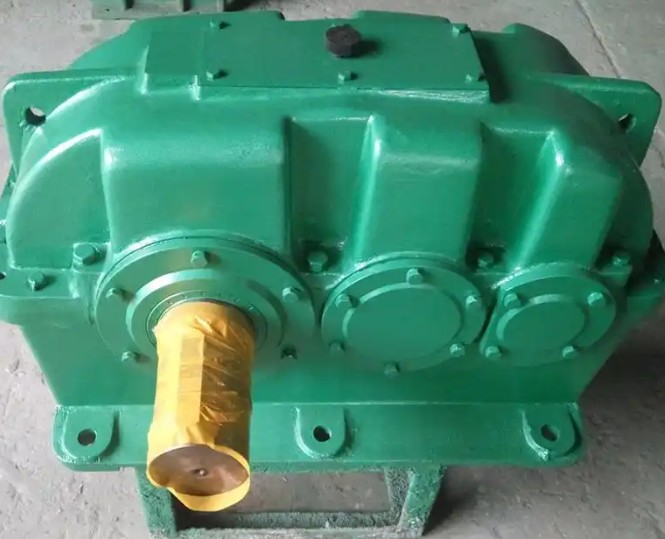
Both types of deviations can lead to a contact area far below the qualified standards of "tooth length ≥ 60%, tooth height ≥ 45%", resulting in a sudden increase in local stress.
2. Rapid increase in vibration and noise during operation
Positive deviation can cause "impact meshing" during gear engagement, resulting in significant periodic abnormal noise and high-frequency vibration during operation; Negative deviation can lead to increased compression friction on the tooth surface, resulting in a continuous "gnawing" sound and a vibration amplitude that is more than 40% higher than normal operating conditions.
When the deviation is too large, vibration will be transmitted to the bearings and housing through the shaft system, causing resonance of the whole machine and further exacerbating component wear.
3. Accelerated tooth surface damage and significantly shortened lifespan
Under positive deviation, stress concentration in the contact area of the tooth tip can easily cause tooth tip collapse and pitting corrosion; Under negative deviation, overloading of the tooth root contact area can lead to tooth root cracks and tooth surface adhesion.
Regardless of the positive or negative deviation, a decrease in contact area will lead to a doubling of the unit pressure on the tooth surface, reducing the normal service life by more than 50%. In severe cases, tooth surface peeling may occur during short-term operation.
4. Decreased transmission accuracy and unstable torque transmission
The large backlash caused by positive deviation can lead to a decrease in the rotational accuracy of the output shaft. Under frequent start stop or reversing conditions, there will be significant "deadstroke" and torque fluctuations, which will affect the transmission stability of the entire machine.
Negative deviation leads to interference meshing of the tooth surface, increased transmission resistance, decreased rated output torque, and even the risk of "stalling".