What factors are related to the vibration frequency of ZDY315-4.5-I gear reducer
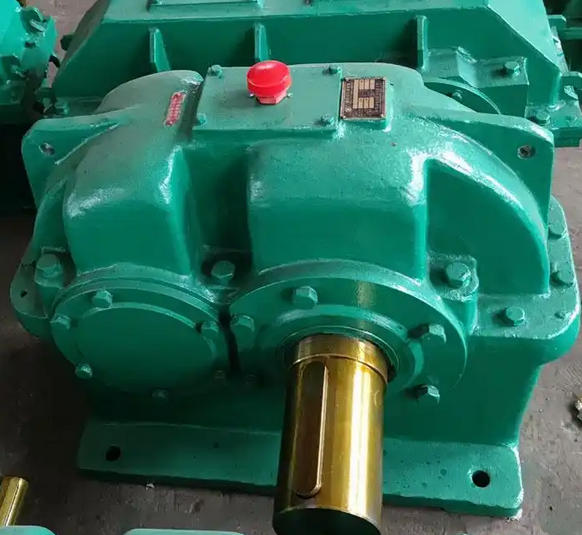
ZDY315-4.5-I is a single-stage hard tooth surface cylindrical gear
reducer, and its vibration frequency core is directly related to input
speed, transmission parameters, and structural component status. At the
same time, it is affected by external factors such as installation and
working conditions. The points are clearly explained and adapted for
practical operation reference:
1. Core transmission parameters
(determining the fundamental characteristic frequency, which is the
fundamental factor of vibration frequency)
One is the input
speed, which directly determines the high-speed shaft rotation
frequency. The formula f ₁=n ₁/60 (n ₁ is the input speed r/min), the
higher the speed, the higher the high-speed shaft rotation frequency,
and the synchronous increase of the meshing frequency, which is the
benchmark for all vibration frequencies; The second is the transmission
ratio (fixed at 4.5), which determines the low-speed shaft rotation
frequency. The formula is f ₂=f ₁/4.5. If the transmission ratio is
fixed, the ratio of high-speed to low-speed shaft rotation frequency
remains constant and will not change with operating conditions; The
third is the number of teeth on the gear, which determines the meshing
frequency. The formula f ₘ=z ₁ × f ₁=z ₂ × f ₂ (z ₁/z ₂=4.5) is used. If
the number of teeth is fixed, the meshing frequency is proportional to
the input speed and is the dominant vibration frequency of gear
transmission, with no room for variation.
2. Internal core component status (determining whether abnormal vibration frequency occurs and related fault determination)
One
is the state of the gear pair. When the gears mesh normally, only the
meshing frequency is stable. If the tooth surface is corroded, peeled
off, or worn, sidebands will appear on both sides of the meshing
frequency; If there is a broken tooth or a broken tooth surface angle,
there will be a significant peak in the superposition of rotational
frequency and meshing frequency; If the meshing gap is too large, it
will cause unstable meshing frequency, accompanied by low-frequency
fluctuations; The second is the bearing status. If the bearing model is
fixed, it corresponds to a fixed characteristic frequency (including
inner ring, outer ring, roller, and cage frequencies). When the bearing
has no faults, this frequency has no obvious peak. If the raceway is
worn, the roller is deformed, or the cage is damaged, the characteristic
frequency of the bearing will be highlighted, accompanied by a doubling
peak; The third is the shaft system state. When the high-speed
shaft/low-speed shaft is not bent and the keyway is not worn, only the
rotation frequency is stable. If the shaft is bent or the keyway is
deformed, it will cause the peak value of the rotation frequency to
increase by 2 times or 3 times, which will also affect the stability of
the meshing frequency.
3. Installation accuracy (affecting vibration frequency amplitude and stability, easily causing abnormal frequency doubling)
One
is coaxiality. If the motor is not aligned with the reducer, or the
reducer is not aligned with the load coupling (radially or diagonally),
it can lead to a significant increase in the second harmonic of the high
and low speed shaft rotation frequency, and in severe cases, it can
superimpose the meshing frequency, causing composite abnormal
frequencies; The second issue is the fixation of the foundation. Loose
foundation bolts and weak foundations can cause irregular fluctuations
in vibration frequency, as well as irregular fluctuations in peak values
of frequency conversion and doubling, which can amplify the amplitude
of all vibration frequencies; The third issue is installation clearance.
If the clearance between the bearing end cover is too large and the
joint surface of the box is loose, it will generate additional
low-frequency vibration and interfere with the basic characteristic
frequency.