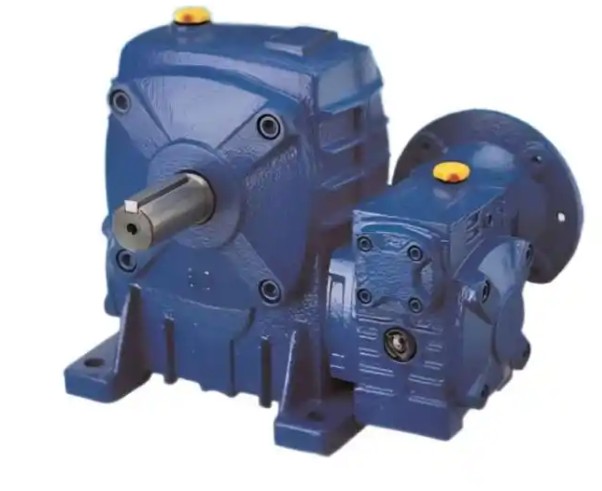
WPEDA120-175-1:800-3KW worm gear reducer basic model and core parameters
The basic model and core parameters of WPEDA120-175-1: 800-3KW worm gear reducer are as follows:
1、 Meaning of Model Identification
WPEDA: Series code for worm gear reducers, where W represents worm gear transmission, P represents planar enveloping toroidal worm gear (some manufacturers use ordinary cylindrical worm gears, which need to be confirmed with the brand), E represents secondary transmission, D represents transmission layout (such as vertical distribution of input and output), and A represents assembly structure type.
120-175: Key installation and structural dimension parameters of the reducer. 120 usually refers to the center distance of the worm gear (unit: mm), while 175 refers to the center distance of the worm gear or key dimensions of the box shape (the definition may vary slightly among different brands, and the manufacturer's manual should prevail).
1: 800: Rated transmission ratio, which is the ratio of input shaft speed to output shaft speed of 800:1, belongs to the category of large transmission ratios and is suitable for low-speed and heavy-duty work scenarios.
3KW: Suitable motor power, refers to the rated input power that the reducer can match, which is 3 kilowatts. It needs to be matched with a motor of corresponding power and flange size for installation.
2、 Core performance parameters
Rated input speed: The conventional speed is 1450r/min (suitable for standard 4-pole asynchronous motors), and the maximum short-term input speed does not exceed 1500r/min. Exceeding this limit can lead to increased wear of the worm gear and worm wheel.
Rated output speed: calculated from the input speed and transmission ratio, 1450r/min ÷ 800 ≈ 1.81r/min. The output speed is stable and has small fluctuations, meeting the low-speed driving requirements.
Rated output torque: Under the input conditions of 3KW and 1450r/min, the rated output torque is approximately 12857N · m (calculation formula: torque T=9550 × P ÷ n × η, where P=3KW, n=1.81r/min, mechanical efficiency η is taken as 0.65-0.75, and the intermediate value is taken as 0.7). The short-term overload torque can reach 1.2-1.5 times the rated value (duration not exceeding 30 minutes).
Mechanical efficiency: The mechanical efficiency of the two-stage worm gear transmission is usually between 65% and 75%, which is affected by the material of the worm gear, machining accuracy, and lubrication conditions. The higher the accuracy and the more sufficient the lubrication, the closer the efficiency is to the upper limit.