What factors need to be considered when adapting the working conditions of the motor and ZSY160-56-VII gear reducer?
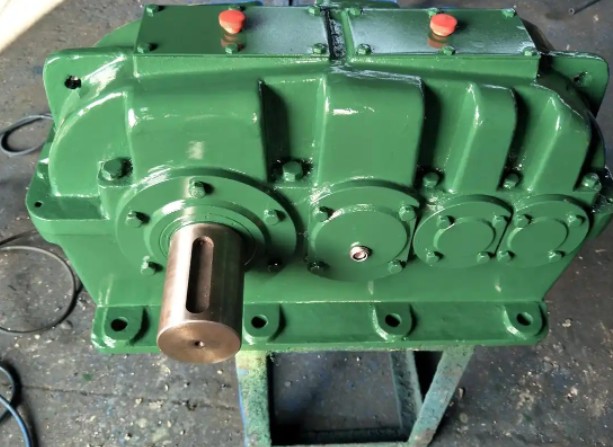
ZSY160-56-VII is a hard tooth surface cylindrical gear reducer with a transmission ratio of 56. The adapted motor needs to be comprehensively considered from five core dimensions: power torque matching, speed characteristic adaptation, installation and connection specifications, environmental compatibility, and operation control coordination, to ensure stable operation and meet the service life standards of the whole machine. The specific details are as follows:
1. Accurate matching of power and torque
The rated power of the motor needs to meet the input power requirements of the reducer, and the calculation formula is: (for the total transmission efficiency of the reducer, the ZSY series multi-stage transmission efficiency is about 94% -96%), to avoid energy waste caused by "big horse pulling small car" or overload burning of the motor and gear damage caused by "small horse pulling big car".
Calculate torque adaptability: The rated output torque of the reducer should be ≥ the maximum working torque of the load × 1.2-1.5 times the safety factor; The starting torque of the motor should be ≥ the starting resistance torque of the reducer, especially for heavy-duty starting conditions (such as crushers and conveyors), high starting torque motors (such as wound asynchronous motors) should be selected.
Pay attention to short-term overload capacity: The allowable short-term overload multiple of the motor should match the short-term overload bearing capacity of the reducer. The instantaneous overload torque of the ZSY160 reducer should not exceed twice the rated value, and the short-term overload current of the motor should be controlled within 1.5-2 times the rated current.
2. Collaborative adaptation of rotational speed characteristics
The rated speed of the motor should match the input speed range of the reducer. The recommended input speed for ZSY series reducers is 1000-1500r/min, and a 4-pole motor (rated speed 1500r/min) should be preferred to avoid excessive centrifugal force and increased wear on the gears caused by overspeed operation.
Considering the adaptability of speed regulation conditions: If the production process requires speed regulation, it is necessary to clarify the motor type (variable frequency motor/ordinary asynchronous motor), and the variable frequency motor should be matched with the speed regulation range of the reducer to avoid insufficient heat dissipation and torque reduction of the motor during low-frequency operation; When using variable frequency speed regulation for ordinary asynchronous motors, the speed regulation range needs to be controlled within 50-500Hz, and a forced cooling fan needs to be installed in the low-frequency range.
Avoiding resonance speed range: It is necessary to calculate the natural frequency of the motor reducer system to ensure that the operating speed of the motor avoids the resonance point of the system, preventing resonance from causing severe vibration and excessive noise.
3. Specification adaptation for installation and connection
Installation method matching: The ZSY160 reducer is installed horizontally, and the motor installation needs to ensure that the coaxiality with the input shaft of the reducer is ≤ 0.05mm, and the end face runout is ≤ 0.03mm. The preferred coupling is an elastic column pin coupling or a plum blossom shaped elastic coupling to buffer the impact of operation. The use of rigid couplings for forced centering is prohibited.
Rigid coordination of the base: The motor and reducer need to be installed on the same rigid base, and the base stiffness should meet 5-8 times the weight of the whole machine to prevent deformation of the base during operation, which may cause shaft displacement; The anchor bolts should be selected with a strength grade of 8.8 or above and fixed using secondary grouting technology.
Matching of shaft extension and keyway: The diameter of the motor output shaft and the specification of the keyway should be consistent with the flange/shaft hole size at the input end of the reducer to avoid the keyway fitting being too loose or too tight, which may cause transmission slippage or shaft deformation.