How to deal with abnormalities that occur during the trial operation of ZQ250-31.5-4 gear reducer
If any abnormalities occur during the trial operation of the ZQ250-31.5-4 gear reducer, it should be stopped immediately for troubleshooting. The root cause of the problem should be systematically diagnosed according to the principle of "from outside to inside, from simple to complex", and targeted treatment should be carried out to avoid equipment damage or safety accidents.
1、 Immediate safety measures taken
Cut off power: Immediately disconnect the power supply of the motor and control system, hang a "Do Not Close" warning sign to prevent accidental start-up.
Release energy: Confirm that the brake has been powered off and released, the frequency converter has completed discharge, and the equipment is completely stationary.
Record phenomenon: Detailed record of abnormal manifestations (such as abnormal noise, vibration, temperature rise, jamming, etc.) for subsequent analysis.
2、 Common types of exceptions and their handling steps
1. Abnormal noise or noise occurs
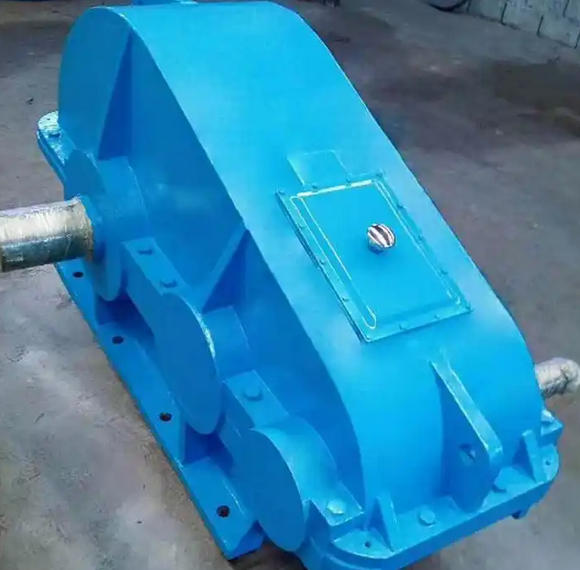
Possible reasons include poor gear meshing, bearing damage, impurities in lubricating oil, or improper gear clearance.
Check the condition of the lubricating oil: Take a sample and observe whether there are metal shavings, moisture, or impurities mixed in. If necessary, replace the gear oil that meets the standards.
Check the meshing condition of the gears: Open the observation hole cover and inspect the tooth surface for pitting, peeling, scratches, or abnormal wear. Adjust the tooth flank clearance to the specified range (usually 0.15~0.3mm).
Check the condition of the bearings: Listen for irregular "clicking" sounds or continuous high-frequency noise to determine if it is caused by bearing damage or insufficient clearance.
2. Excessive vibration
Vibration usually originates from installation issues, component wear, or misalignment.
Check whether the anchor bolts are loose, whether the foundation is firm, and whether there are cracks or settlement in the concrete.
Verify the alignment accuracy of the coupling: Use a dial gauge to measure the radial and axial deviations, ensuring they are ≤ 0.05mm.
Check whether the input/output shaft is bent, whether the bearings are worn or damaged, and replace them if necessary.
3. Excessive temperature
During the trial operation, the temperature of the casing or bearing parts rises rapidly, which may be caused by improper lubrication, overload, or poor exhaust.
Check the oil level: The oil level should be at the center line of the oil gauge. Too high or too low can cause poor heat dissipation.
Confirm whether the lubricating oil model matches the working conditions, especially when using low pour point gear oil (such as L-CKD 150 # or synthetic oil) in low-temperature environments.
Check if the exhaust valve is blocked and ensure that the pressure inside the box is released normally.
4. The reducer does not rotate or gets stuck (the motor is normal)
If the motor is running but the gearbox has no output, it is necessary to investigate the power transmission path.
Disconnect the load end coupling and manually turn the gearbox to check if the gearbox body is stuck.
If it can be easily rotated, the problem may be at the load end (such as being stuck by materials); If it cannot rotate, it is necessary to dismantle and inspect the internal gears or bearings for damage.
Check if the brake is not fully released or if the connection between the input shaft and the motor is loose.